
Davie County Court Records After Arrest
Davie County criminal cases are handled through the North Carolina Judicial Branch Davie County court system. After an arrest, the person may be booked at the Davie County Detention Center, but that booking entry is not the full court record. The jail side may show the arrest date and hold reasons. The court side shows the case number, parties, filed charges, hearings, release conditions, and final disposition. Davie County is part of Prosecutorial District 33, Superior Court District 33, and District Court District 33.
The arrest-to-court path usually moves in stages: arrest, booking, first appearance or magistrate review, prosecutor review, formal case filing, hearings, and disposition. The District Attorney's Office for District 33 handles state criminal prosecution for Davidson and Davie counties. The sheriff's office may hold the person and publish roster data, while the prosecutor decides whether to proceed, amend, reduce, dismiss, or seek indictment on charges. That is why court records after a Davie County jail arrest should be checked in court channels, not only in the jail roster.
Custody and booking details are better matched to Davie County jail inmate records, while booking photos belong with Davie County jail mugshots. The court record answers a different question: what charge was filed, where the case sits, and whether the charge ended in dismissal, plea, verdict, or another court outcome.
Find Davie County Court Records
The main online channel is the NC eCourts Portal and Smart Search described by the Judicial Branch. Public users can search case information online, and training materials describe filters for location, party name, date of birth, case type, case status, and filing-date range. The same Judicial Branch help material says criminal case information can also be accessed at public self-service terminals in clerk offices, with searches by defendant name, case number, or victim or witness name.
The NC Portal training page shows the Smart Search and hearing-search options used for public case lookup. The Davie County courthouse page gives the courthouse location and clerk phone, while the court contact directory lists criminal, district attorney, and magistrate phone contacts. For paper files or certified copies, use the Clerk of Superior Court rather than the county public-records form, because court files are Judicial Branch records.
- Open the NC eCourts Portal or start from the Judicial Branch Davie County location page.
- Search by defendant name or case number. Use Davie County as the location filter when that option is available.
- Open the matching criminal case and review the charge list, case status, filing date, and hearing entries.
- Compare each charge with the jail hold reason, since roster text can differ from charges the prosecutor later files.
- Call the Davie County Clerk of Superior Court or use a clerk public terminal if the online result is unclear.
The Judicial Branch cautions that people performing background checks should use the county clerk's office rather than relying only on Portal results. That matters because a casual case lookup may miss older, restricted, sealed, or name-variant records. It may also show pending charges that are not convictions.
Davie County Court Search Fields
NC Portal documentation gives enough detail to map the public court search fields used after a Davie County arrest. Smart Search is the broad case-search tool. Search Hearings is better when a court date, courtroom, attorney, or judicial officer is the issue. Use exact names when possible, then try wildcard rules from the training material if spelling is uncertain.
| Search Tool | Field / Filter | Type | Required | Notes |
|---|---|---|---|---|
| Smart Search | Case number | text | no | Training examples use a format such as 21CR000003-910. |
| Smart Search | Party name | text | no | Name wildcard searching can use at least three last-name characters plus an asterisk. |
| Smart Search | Location | filter | no | Use Davie County or the relevant court location when available. |
| Smart Search | DOB | date/filter | no | Helpful when several people share a similar name. |
| Smart Search | Case type | filter | no | Use Criminal Actions for state criminal cases. |
| Smart Search | Case status | filter | no | Separates pending and disposed cases where the field is available. |
| Search Hearings | Party name or case number | text | no | Used to find hearing dates, times, and locations. |
The Davie County Courthouse page lists the courthouse at 140 South Main Street, Mocksville, NC 27028, and the main clerk phone as (336) 936-3000. The court contact directory lists Criminal at (336) 936-3002, District Attorney - Mocksville at (336) 936-3010, and Magistrate - Mocksville at (336) 936-3019.
The Judicial Branch Davie County page is shown in the captured source image from the official Davie County court location page.
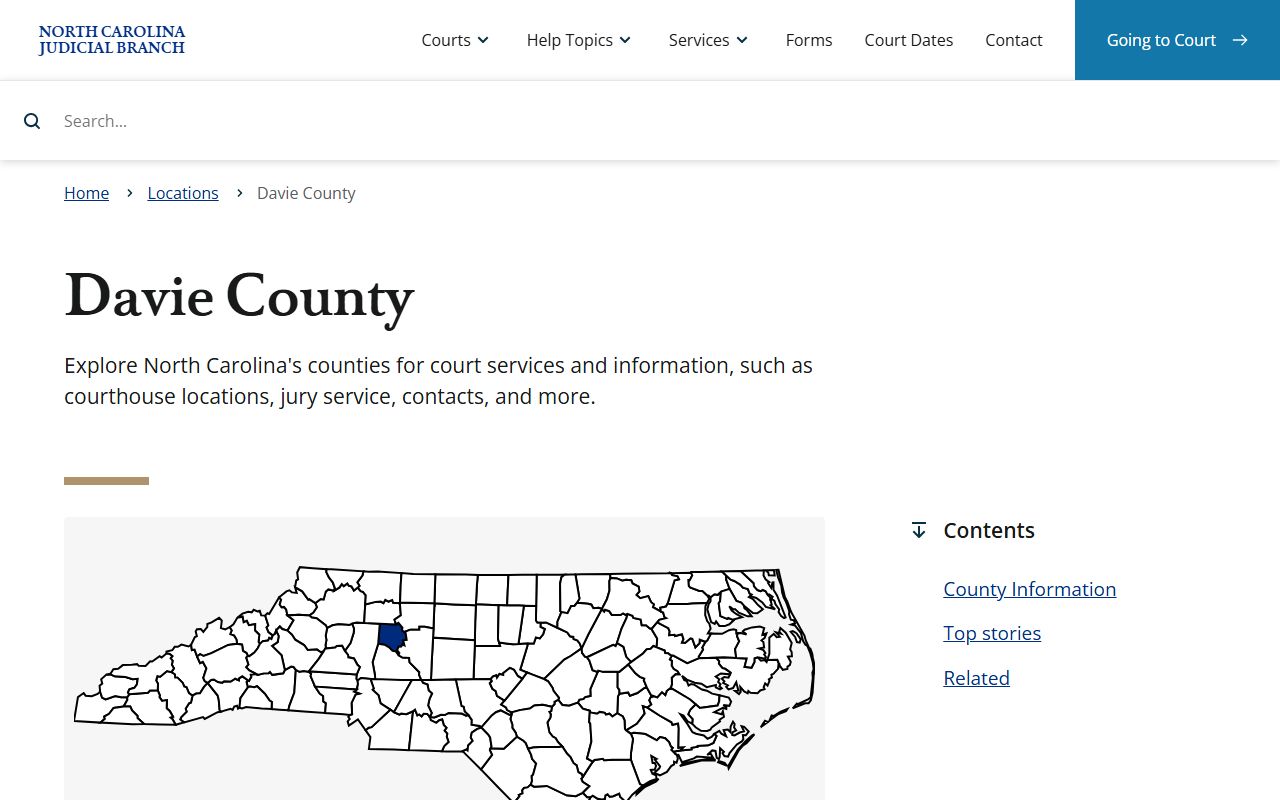
That county page is the local doorway for court calendars, courthouse contacts, payment information, and eCourts updates tied to Davie County criminal cases.
Davie County Arrest Charging Documents
A jail roster may show a hold reason soon after booking, but a court case depends on a charging document. In North Carolina practice, a charge may begin through a warrant, citation, magistrate process, criminal summons, bill of information, or indictment depending on the offense and case path. The research instructions call out complaint, information, and indictment as the core document types to explain, so the table below keeps the distinction plain.
| Document | Who Starts It | Common Use | What It Means in the Court Record |
|---|---|---|---|
| Complaint | Officer, complainant, or prosecutor process | Early criminal accusation or magistrate-linked process | Creates or supports the first charge record after arrest. |
| Information | Prosecutor | Formal prosecutor-filed charge where allowed | Shows the DA is proceeding on stated charge language. |
| Indictment | Grand jury | Serious felony cases and superior court prosecution | Shows formal grand-jury accusation and can replace or supersede earlier charges. |
Formal charges can change after arrest. A charge may be amended, reduced, dismissed, indicted, superseded, or resolved by plea or verdict. When Davie County court records after a jail arrest do not match the first roster text, the court record controls the current prosecution status.
Davie County Charge Status
Charge status is the bridge between a booking entry and the final court result. A pending charge means the allegation remains active. A dismissal means the case or count did not proceed to conviction. A guilty plea or guilty verdict is a conviction unless a special disposition applies. Some North Carolina outcomes can be more nuanced, including deferred matters, probation, or prayer for judgment continued.
| Status | What It Means | Why It Matters After Arrest |
|---|---|---|
| Pending | The charge remains open in court. | Future hearings or court dates should be checked. |
| Amended or reduced | The filed charge changed from an earlier version. | The roster charge may no longer match the court charge. |
| Dismissed or voluntary dismissal | The charge was ended without conviction. | Eligibility for expunction may depend on the case facts and law. |
| Guilty | A plea or verdict found guilt on the charge. | The record is no longer only an allegation. |
| Not guilty | The defendant was not convicted after trial. | The arrest may still appear unless sealed or expunged where eligible. |
Note: Use the clerk or court record for final disposition, because jail roster hold reasons are not conviction records.
Bond After Davie County Arrest
North Carolina pretrial release is governed by G.S. 15A-534. The law allows a judicial official to impose conditions designed to secure court appearance and address safety concerns. Davie County research found no official page with a detailed bond-payment method or after-hours payment schedule, so the safe route is to confirm current instructions with the jail, magistrate, clerk, or a licensed bond professional before attempting payment.
| Bond Type | How It Works |
|---|---|
| Written promise to appear | The defendant signs a promise to attend court without posting money. |
| Unsecured bond | No upfront cash is paid, but failure to appear can trigger the bond amount. |
| Secured bond | Cash, property, or surety backs release from custody. |
| Cash bond | Money is posted through the required court, jail, or magistrate process. |
| No-bond hold | Release is unavailable until a court changes conditions or a separate hold is cleared. |
Hold situations can block release even when one charge has a bond amount. Examples include another county warrant, probation or parole matter, federal hold, ICE detainer, contempt order, or a court order. Davie County's public roster configuration does not clearly publish bond fields, so current release conditions should be verified by phone or court record.
Warrants After Davie County Arrest
Warrants can explain why a person was booked, why a court case appears, or why release is delayed. Research found generic Zuercher warrant-search templates, but no confirmed active public Davie County warrant page in the official sheriff source reviewed. The sheriff app exists, yet the official app-store text does not confirm a warrant-search feature. Do not treat a missing online warrant result as proof no warrant exists.
For warrant-routing questions, the Davie County Sheriff's Office main office is (336) 751-6238 and nonemergency is (336) 751-0896. Court-linked warrants, orders for arrest, and failure-to-appear matters can also involve the Davie County Criminal Clerk at (336) 936-3002 or Magistrate - Mocksville at (336) 936-3019. Immediate law-enforcement emergencies should use 911, not an online roster or app.
Davie Charges vs Convictions
An arrest charge is an accusation or custody basis. A court charge is the formal allegation in the criminal case. A conviction exists only after a guilty plea, guilty verdict, or other adjudication that legally counts as a conviction. This distinction is central to Davie County court records after a jail arrest because a person may be arrested and charged without ever being convicted.
| Point of Comparison | Charge | Conviction |
|---|---|---|
| Stage | Accusation after arrest or filing | Final legal outcome after plea, verdict, or adjudication |
| Proof level | Probable cause or formal allegation | Proof beyond a reasonable doubt or valid guilty plea |
| Where checked | Jail roster, warrant, citation, or court case | Court disposition and criminal-history record |
| Public meaning | Not proof of guilt | May affect sentencing, supervision, and background checks |
Sealed and Expunged Records
North Carolina public-record law starts with broad access under G.S. Chapter 132, but criminal investigation records, juvenile matters, protected personal data, and sealed or expunged records can be restricted. The Judicial Branch court-records help material routes users to expunction information when eligible charges or convictions may be cleared from public access.
| Point of Comparison | Sealed | Expunged |
|---|---|---|
| Public visibility | Hidden or restricted from ordinary public access. | Removed from public record access where the order applies. |
| How it happens | By court rule, statute, or order. | By petition or qualifying process under North Carolina law. |
| Agency access | Some official access may remain. | Access depends on the expunction law and order terms. |
| After dismissal | Not automatic in every public system. | May require a separate court expunction process. |
Public-record limit: G.S. 132-1.4 protects criminal investigation and intelligence records, while still preserving public access to certain arrest and alleged-violation information.
Restricted Davie Court Records
Not every court or arrest-related record is public online. Juvenile matters, sealed cases, expunged records, medical information, protected identifying data, and active investigative material may be withheld or redacted. Law-enforcement agency recordings have a separate disclosure and release process under G.S. 132-1.4A. County public-records policy also allows review for protected information before release.
Davie County's public-records request page and Laserfiche request form are useful for county or sheriff records, but local court files usually go through the Judicial Branch, clerk, Portal, or public terminal. Requests for municipal records must go directly to Bermuda Run, Cooleemee, or Mocksville when those municipalities hold the record.
Background-check caution: Casual searches are not FCRA consumer reports and should not be used for employment, tenant, credit, or insurance screening.
Davie County Court Contacts
The main court contacts are local and specific. The courthouse is at 140 South Main Street in Mocksville. The Clerk of Superior Court main phone is (336) 936-3000, and the criminal clerk line listed in the Judicial Branch contact directory is (336) 936-3002. District Attorney Garry Frank serves Prosecutorial District 33, which covers Davidson and Davie counties.
For charge status, case copies, and public terminals, start with the clerk or Portal. For prosecution questions, use the District Attorney contact. For release conditions, use the court record, magistrate, or jail phone as appropriate. VINELink can help with custody-status notifications, but it does not replace a court docket or clerk record.